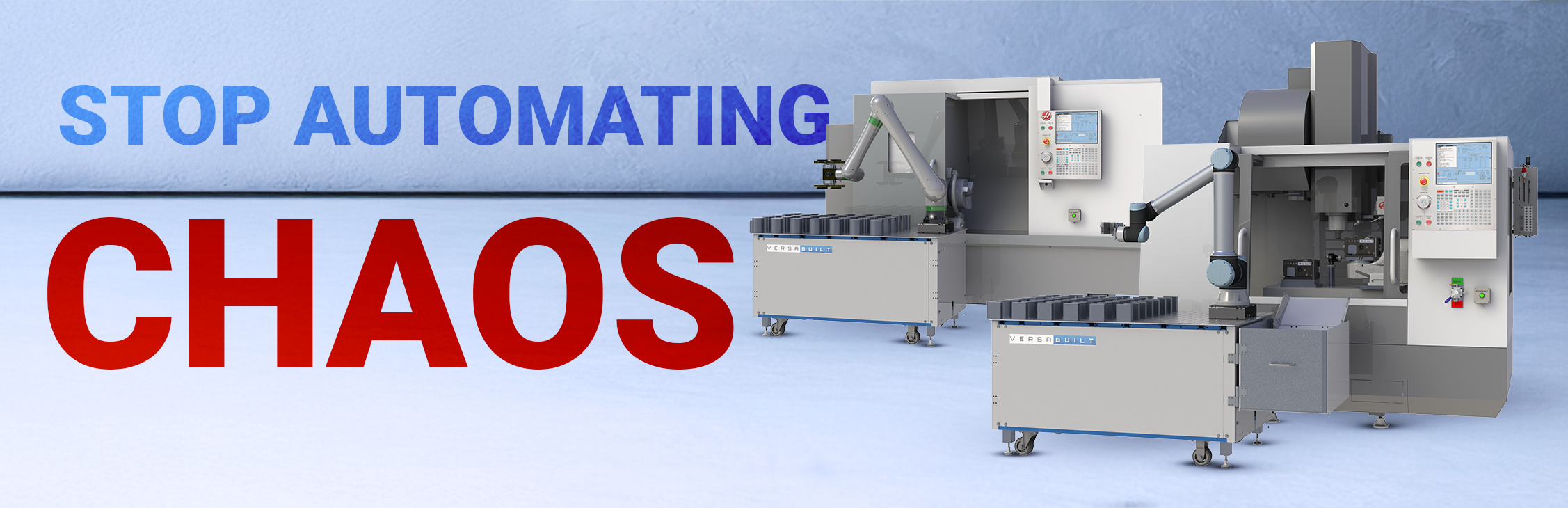
High-mix CNC automation works when you remove the constraint — not when you pile on complexity.
Most automation fails not because of robots — but because it targets variability instead of the bottleneck that controls throughput.
Constraint vs. Chaos — What’s the Difference?

Automating Chaos
- Tries to handle every part variation
- Over-engineered systems
- Long lead times
- Fragile automation that breaks with change
- Operators carry the burden
Automating the Constraint
- Targets the bottleneck controlling throughput
- Standardized, intentional design
- Faster ROI
- Systems that still work when jobs change
- Operators gain leverage, not responsibility
If automation feels complicated, it’s usually aimed at the wrong thing.

Our Point of View on Automation
- We sell installed automation capacity, not robots
- Outcomes matter more than hardware
- High-mix automation is harder to design — and easier to operate
- Complexity belongs in engineering, not on the shop floor
- Good automation feels boring on Monday morning
Who This Is For
✔ High-mix CNC shops
✔ Operator- or changeover-constrained
✔ Parts under 50 lbs
✔ Existing machines (mills and/or lathes)
✔ Shops that value throughput over elegance
Who This Is NOT For
✖ Prototype-only or one-off work
✖ Elegance-first automation
✖ DIY integration projects
✖ RFP-driven price shopping
If you’re optimizing for how automation looks instead of how it runs, VersaBuilt is probably not the right fit.
Does this resonate? Let’s talk next steps.

See why most automation fails — and what works instead.
LEARN MORE
Let’s talk about how automation can solve your shop’s constraint.
GET STARTED
Get automation insights delivered straight to your inbox.
SUBSCRIBE TO NEWSLETTER