“Physical AI” and no-programming robots are two of the biggest conversations in industrial automation right now.
And for good reason.
Physical AI may make automation applications economical that have historically been too expensive to develop using traditional teach-pendant robot programming methods. Anything that lowers the engineering burden of deploying robots is important progress.
But there is a danger in confusing the elimination of robot programming with the solution to high-mix CNC automation.
At VersaBuilt, we have been shipping CNC automation systems that allow customers to add their own parts without robot programming for about 13 years.
That experience taught us something important:
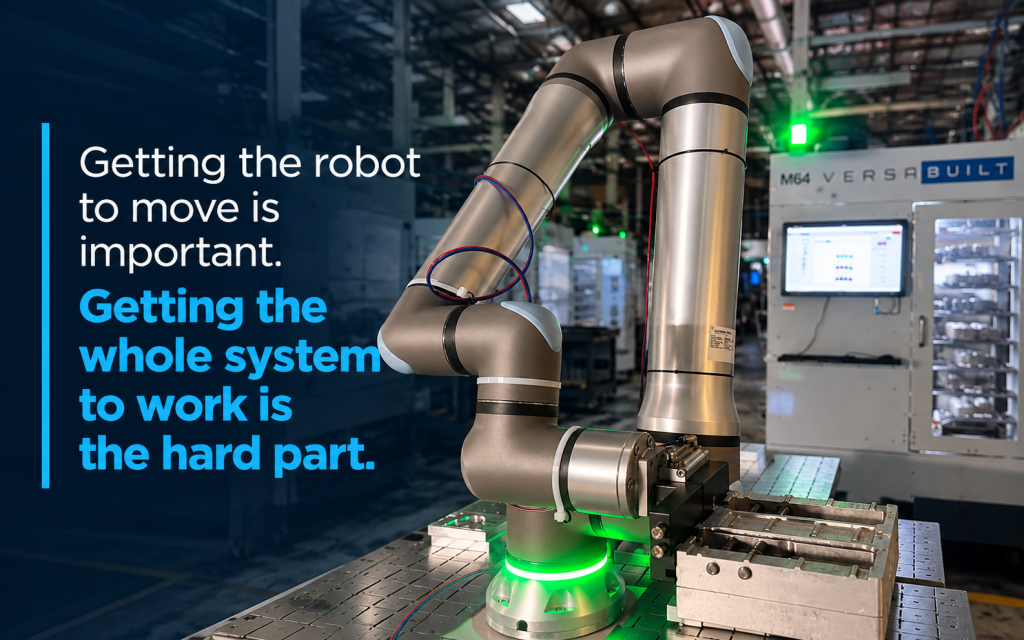
Robot programming isn’t the hard part. Making the entire high-mix automation system work is.
Eliminating robot programming was only the beginning.
Traditional automation works extremely well when you can justify substantial engineering around one product.
If you are going to manufacture the same part for several years, it may make perfect sense to design custom fixtures, custom part presentation, custom robot programs and a highly optimized dedicated process.
High mix is different.
You may want to automate dozens of parts—and eventually hundreds.
If every new part requires another mechanical design project, another custom infeed fixture, another robot-programming project and another visit from the integrator, the economics deteriorate quickly.
A high-mix CNC automation system should therefore be designed around two fundamental objectives:
Adding a new part should require as little engineering effort as possible.
And:
Changing from one established part to another should take minutes, not hours.
Those two requirements affect almost every component in the automation system.
Start with material presentation.
In a traditional automation application, an integrator may design a custom tray, nest or fixture that precisely locates raw parts for the robot.
That can work extremely well—until the next part is different.
For high mix, repeatedly designing and manufacturing dedicated part locators becomes expensive.
That is one reason VersaBuilt developed our patented intelligent infeed technology. The goal was to present a broad range of part sizes and geometries to the robot without requiring custom part locators for every new job, while software makes efficient use of the available infeed capacity.
The same principle applies throughout the system.
Your robot gripper needs to accommodate a useful range of parts.
Your CNC workholding needs to support rapid setup and changeover.
Your automation software needs to let your people configure another production job without writing robot code.
And the process needs to be flexible enough that an ordinary new part does not become another automation engineering project.
So instead of asking:
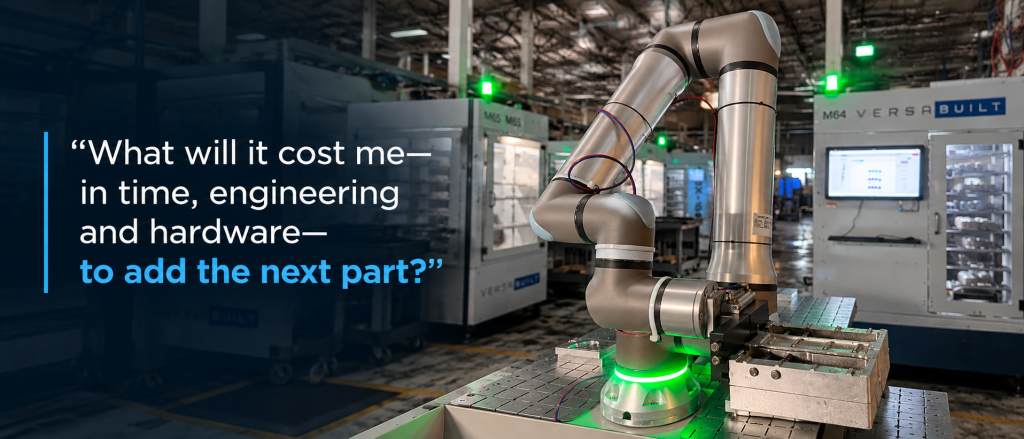
“How easy is this robot to program?”
Ask:
“What will it cost me—in time, engineering and hardware—to add the next part?”
Those are very different questions.
A modern industrial robot is extremely good at repeatable motion.
Most CNC automation is built from a relatively small vocabulary of actions:
Pick a part.
Orient it.
Open the machine.
Clean the workholding.
Load the part.
Clamp it.
Start the CNC.
Unload the completed part.
Clean the workholding.
Reorient or transfer the part if another operation is required.
Move the finished part out of the process.
None of those actions is particularly exotic by itself.
The difficult part is combining them into a reliable and efficient manufacturing process.
A good process coordinates the robot, CNC, workholding, part handling, cleaning and other activities. A better process pipelines activities where possible so the robot and CNC are working concurrently rather than unnecessarily waiting for one another.
As you add operations, regrips, transfers and multiple machines, the process becomes more sophisticated.
But the objective remains the same:
Create a reliable production process, not an impressive robot-motion demonstration.
That is why we think:
No robot programming is a feature. A reliable, optimized CNC automation process is the product.
This is common with established production.
Your CNC programs may have been running for years.
Your workholding works.
Your quality process is established.
And in industries such as medical device or aerospace manufacturing, changing a proven process may introduce substantial validation or qualification work.
Sometimes the geometry or machining sequence simply does not fit one of the standard automation approaches.
Traditional custom automation can solve that.
But traditional custom automation often means designing the entire system around a single application.
That can be an excellent solution for a high-volume product with a long production life.
It is harder to justify when volume is moderate, product life is uncertain, or you know the automation equipment will eventually need to run something else.
There is a useful middle ground.
VersaBuilt can begin with a standard, proven CNC automation platform and engineer only the application-specific elements required to automate the existing process.
Those might include a custom automation process, application-specific infeed or regrip fixtures, custom grippers or custom CNC fixtures—all designed to work with the existing CNC equipment, manufacturing process and, where practical, the existing CNC programs.
The result is very different from designing an entirely dedicated automation system from scratch.
You retain a reusable automation platform.
When today’s job eventually disappears, much of the system can be redeployed to another CNC or another application.
The custom engineering is concentrated where it actually creates value.
That distinction becomes increasingly important as AI enters automation engineering
One of the most useful principles in CNC automation is to avoid unnecessary workpiece handling.
Every time the robot releases and reacquires a workpiece, you add another motion sequence, another gripping event and another opportunity for failure.
Machine-tool builders solved one version of this problem a long time ago.
In some respects, a dual-spindle lathe is the original expression of the same idea behind MultiGrip.
The first spindle can transfer a workpiece directly to the second spindle so another operation can be completed without requiring the robot to unload, regrip and reload the part between operations.
It is an elegant way to move a workpiece through the manufacturing process while reducing handling complexity.
For many milling applications, VersaBuilt’s patented MultiGrip technology applies a related principle.
MultiGrip can carry the workpiece through multiple machining steps while reducing robot handling, decreasing automation complexity and improving reliability.
But MultiGrip is not automatically the right answer for every milling application.
There are good applications where a dual-headed gripper is the better solution. Other workholding or handling strategies may make more sense in still others.
After years of applications work, we have learned not to force every part into one automation architecture.
Our job is to understand how you make the part and guide you toward the process that makes the most sense.
The objective is the production outcome.
Automation demonstrations tend to happen in clean environments.
Production machining does not.
There are chips and coolant.
Chips get caught where you do not want them.
Raw stock varies.
Jaws get dirty.
Machines alarm.
Cycles get interrupted.
Operators make mistakes.
Eventually something happens at 2:00 in the morning that nobody thought about during the demo.
Getting a robot to move successfully in an application demonstration is one problem.
Making an automated CNC system run production day after day is another.
That requires things that are much less glamorous than AI robot motion:
Chip management, process verification, fault detection, recovery strategies, monitoring, logging and remote support.
These details accumulate over years.
We have spent more than a decade finding things that can go wrong and designing as many of those lessons as possible back into the system.
That experience is embodied in VersaBuilt’s patented intelligent infeed technology, patented MultiGrip technology, robot grippers, CNC workholding, dedicated CNC automation software, process architecture, chip-management strategies, monitoring, recovery capabilities and support systems.
Experience only matters if it changes the product.
VersaBuilt is here to support you, but routine new-part integration and changeover should not depend on bringing the system integrator back every time your production schedule changes.
Your people should add parts.
Your people should perform changeovers.
Your people should operate the system.
Our responsibility is to design technology that makes that practical—and to be there when you need help.
That is not simply a training philosophy.
It is part of the architecture required to make high-mix automation economical.
If every change in your production schedule creates another engineering-services purchase order, the system has not really solved the high-mix problem.
This is where the current Physical AI discussion becomes genuinely interesting.
If Physical AI can eliminate much of the custom robot programming required for difficult applications, it may substantially reduce engineering cost compared with traditional teach-pendant programming.
That could make previously uneconomic automation applications practical.
But consider an established CNC manufacturing process that does not fit one of the standard automation processes.
If AI eliminates the custom robot programming, has it eliminated the need for custom automation engineering?
I don’t think so.
Someone—or something—still needs to determine:
How will the material be presented?
Where can the part be gripped?
Does the process require a regrip?
What CNC workholding is required?
How will chips be cleared?
How will the automation coordinate with the existing CNC program?
How should the process be sequenced and pipelined?
What happens when something goes wrong?
How will the application be tested and validated?
And ultimately:
Will it reliably make good parts?
That is a much bigger problem than writing robot code.
VersaBuilt has been developing application-specific CNC automation processes for more than a decade.
Historically, skilled automation engineers did that work using traditional engineering and programming tools.
Today, generative AI gives us another tool.
That raises what I think is one of the most interesting questions in industrial automation:
Where should the intelligence live—in engineering the production process, or in executing it?
One approach is to put more intelligence into runtime operation, using perception and Physical AI to make more decisions as the robot performs the task.
Another is to use AI to reduce the engineering effort required to develop an application-specific process, validate that process, and then execute it using mature industrial robot controls and proven production logic.
In other words:
Use AI to help engineer the process. Then let proven industrial automation execute the validated process predictably and repeatedly.
That does not mean Physical AI is wrong.
Physical AI may prove to be the best architecture for many automation problems, particularly when the environment or task cannot economically be modeled in advance.
For other production applications, there may be substantial advantages to doing more of the intelligence at engineering time and minimizing variability during production execution.
Many future systems will almost certainly combine both approaches.
The important comparison is not which system creates the most impressive robot demo.
It is:
Which approach gets your application into production economically, runs it reliably, recovers gracefully when something goes wrong, and continues making good parts thousands or millions of cycles later?
That is the test that matters.
Thirteen years ago, eliminating robot programming from the customer’s new-part integration process felt like a major accomplishment.
It was.
But hundreds of customer applications taught us that it was only one part of the problem.
Successful high-mix CNC automation requires the entire system to be designed around the realities of high mix:
Low-cost new-part integration.
Fast changeover.
Flexible material presentation.
Flexible gripping.
The right CNC workholding.
Reliable and optimized automation processes.
Chip management.
Monitoring and recovery.
Customer ownership.
And support when the real world inevitably does something unexpected.
That is why I remain excited about Physical AI—and skeptical of the idea that eliminating robot programming, by itself, solves high-mix CNC automation.
Getting the robot to move is important.
Getting the whole system to work is the hard part.